
Research Symposium
26th annual Undergraduate Research Symposium, April 1, 2026
Abigail Pfeiffer Poster Session 2: 10:45 am - 11:45 am / Poster #102

BIO
Abigail is a first-year pre-law student at Florida State University majoring in Environmental Science and Policy. Her research was conducted under the mentorship of Florida State University College of Law Professor Mason Marks, J.D. She is a member of the Phi Alpha Delta Pre-Law Fraternity, the Gamma chapter of Chi Omega sorority, the FSU International Program, and Best Buddies. Abigail plans to pursue a career as an attorney focusing on environmental and international litigation cases where she can reform policies that threaten ecological sustainability, generate solutions to minimize greenhouse gas emissions, and draft international compliance agreements that enhance global governance and environmental accountability.
Impact of MDMA Policy Differences Between the U.S. and Australia on PTSD Affected Individuals
Authors: Abigail Pfeiffer, Mason MarksStudent Major: Environmental Science and Policy
Mentor: Mason Marks
Mentor's Department: Florida Bar Health Law Section Mentor's College: Florida State University College of Law Co-Presenters:
Abstract
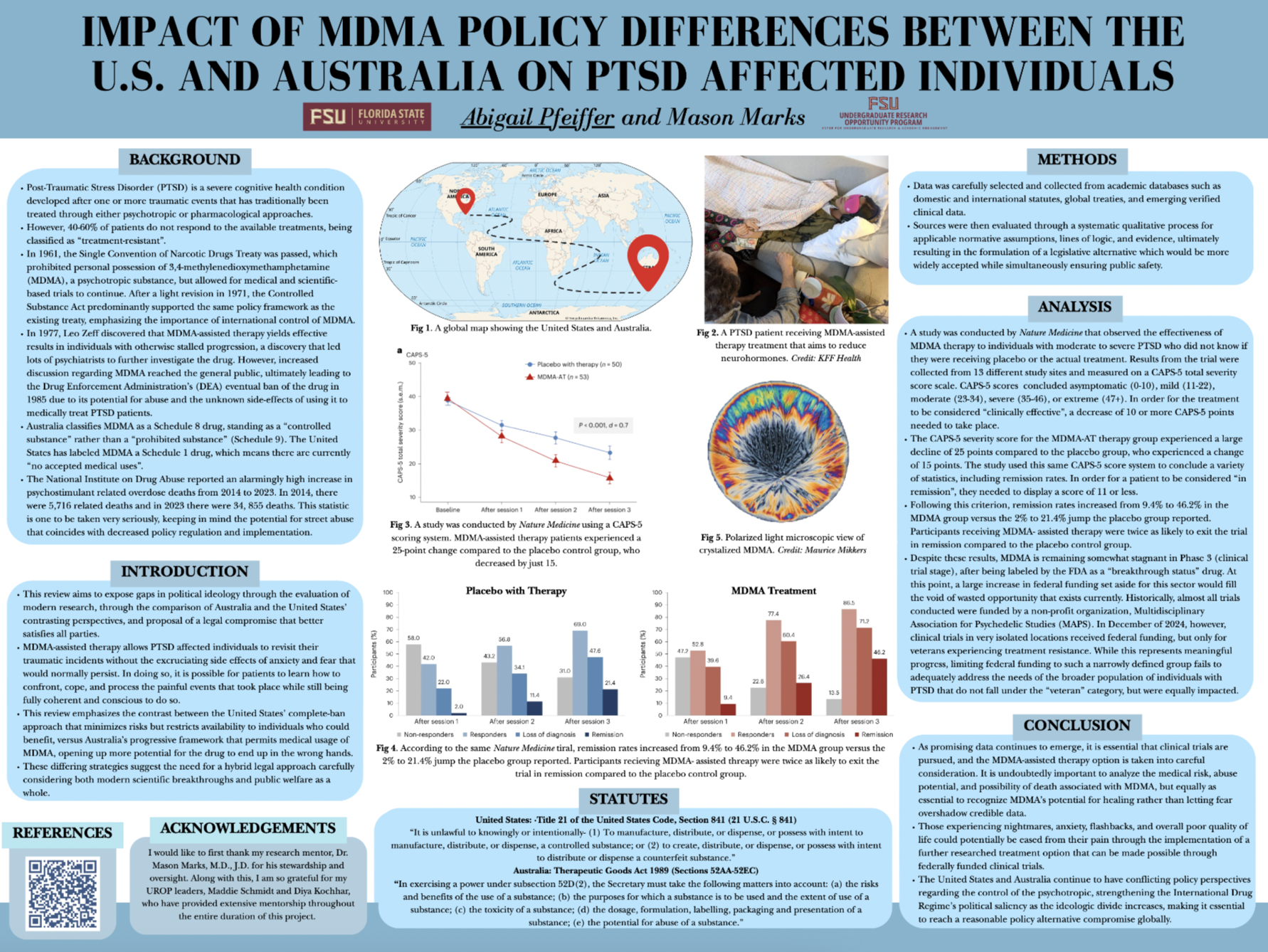
Post-Traumatic Stress Disorder (PTSD) is a severe cognitive condition with individuals often exhibiting subconscious resistance to existing treatments. In 1977, Leo Zeff began using 3,4-methylenedioxymethamphetamine (MDMA) to treat individuals in this predicament, but the drug was later banned by the Drug Enforcement Administration (DEA) due to addiction concerns. New findings from clinical trials prompted Australia to campaign for a more lenient MDMA policy framework. This review aims to expose gaps in political ideology through the evaluation of modern research, comparison of Australia and the United States’ contrasting perspectives, and proposal of a legal compromise that better satisfies all parties.
Data were collected from academic databases such as statutes, global treaties, and clinical studies, then evaluated through a qualitative process. Sources were evaluated for their normative assumptions, lines of logic, and evidence, ultimately resulting in the formulation of a legislative alternative which would be more widely accepted while ensuring public safety.
Analysis reveals the difference between the US and Australia's approach to MDMA usage in regard to PTSD treatment. Studies have shown that 40-60% of patients do not respond to pre-existing PTSD treatment options; however, MDMA-assisted therapy trials have concluded increased remission rates from 9.4% to 46.2%. This review emphasizes the contrast between the United States’ complete-ban approach that minimizes risks but restricts availability to individuals who could benefit, versus Australia’s progressive framework that permits medical usage of MDMA. These differing strategies suggest the need for a hybrid legal approach considering both modern breakthroughs and public welfare.
Keywords: law, drug, international