
Research Symposium
26th annual Undergraduate Research Symposium, April 1, 2026
Lauren Phillips Poster Session 3: 1:45 pm - 2:45 pm / Poster #211

BIO
Lauren is passionate about scientific innovation. Her passion for science has developed since being at Florida State University where she is currently a first-year student, majoring in Biochemistry and participating in undergraduate research under the mentorship of researchers Dr. Ming Ye from the Department of Earth, Ocean, and Atmospheric Science (EOAS), where she is working to help optimize f-sand's ability to remove nutrients from bodies of water, primarily nitrate and phosphate. Her focus on this project is performing laboratory experiments to determine the best methods for large-scale production of f-sand. From working on this project, she has gained experience in technical literature review, ion chromatography, sampling, data collection and analysis, and laboratory work. She plans to continue research at the Air Force laboratory this summer of 2026 at the Kirtland Air Force Base, where she will be supporting research for the chemical dynamics of thruster plumes, and will work to model how chemicals are modified by the space environment with an emphasis on ultraviolet photons. She was awarded to the president's list at Florida State University after completing her first semester. She plans to use her degree in Biochemistry to pursue a career in patent law. Her interest in pursuing patent law comes from her passion for science and her technical reading and writing skills. She wants to be involved with as much research and innovation as possible before her career goals to best prepare herself for a future position as a patent attorney.
Optimizing the Creation of Moringa oleifera F-sand for Large Scale Filtration of Eutrophicating Nutrients
Authors: Lauren Phillips, Dr. Ming YeStudent Major: Biochemistry
Mentor: Dr. Ming Ye
Mentor's Department: Department of Earth, Ocean, and Atmospheric Science Mentor's College: College of Arts and Science Co-Presenters: Logan Soloman
Abstract
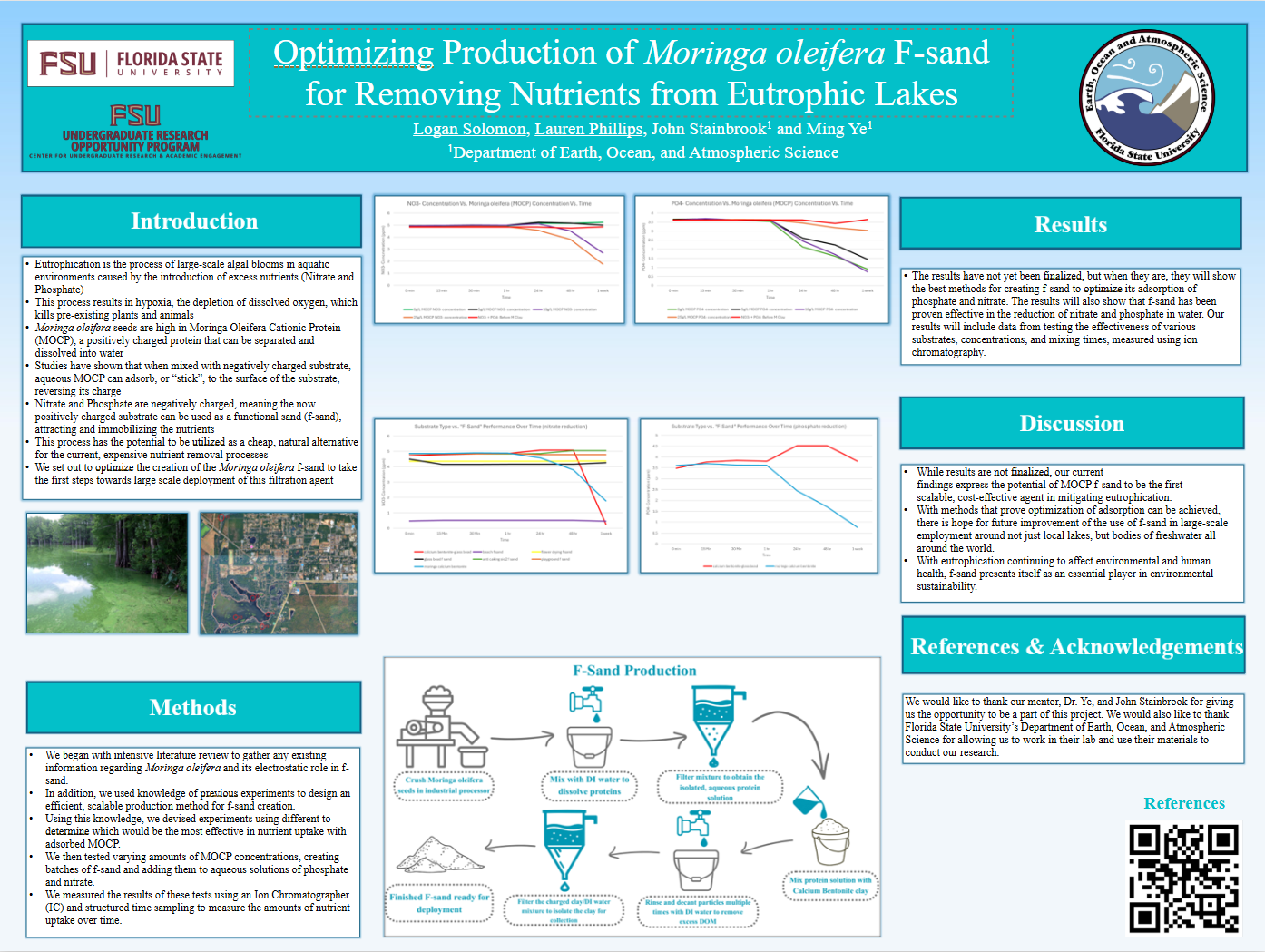
Eutrophication occurs when an excessive amount of nitrogen and phosphorus enters a body of water, causing large-scale algal blooms that severely deplete the dissolved oxygen, resulting in detrimental effects on the environment. Moringa oleifera cationic protein (MOCP) is a naturally occurring seed protein from the Moringa tree that electrostatically adsorbs to the surface of negatively charged substrates, reversing their charge and creating a functional sand (f-sand). F-sand can then be used as a filtration agent by attracting and immobilizing the negatively charged anions that drive eutrophication. This mechanism has previously only been observed at small scales, so we sought to be the first to optimize a scalable method for f-sand production. Initially, through literature review, we devised experiments using differing fine substrates to determine which would be the most effective. These experiments entailed mixing and vacuum filtering different substrates with varying aqueous concentrations of MOCP which were then added to nutrient solutions. We used an Ion Chromatographer (IC) to quantify nutrient uptake over time. Our preliminary results conclude that calcium bentonite is the optimal substrate to maximize nutrient removal by f-sand. Experiments are ongoing to determine the most efficient concentration of MOCP for large-scale deployment. While results are not finalized, our current findings express the potential of MOCP f-sand to be a scalable, cost-effective agent in mitigating eutrophication. With this, further research is necessary to evaluate real-world effectiveness of f-sand and develop efficient methods of strategic deployment.
Keywords: environmental, biochemistry, aquatic