
Research Symposium
26th annual Undergraduate Research Symposium, April 1, 2026
Riley Dehlinger Poster Session 3: 1:45 pm - 2:45 pm / Poster #263

BIO
Riley Dehlinger is a second-year undergraduate at Florida State University seeking a Bachelor of Science in Biological Science and minors in both Interdisciplinary Science and Chemistry. She is a member of the Phi Beta Kappa Honor Society and has worked in Dr. P Bryant Chase's and Dr. Jose Pinto's labs for the past 2 semesters studying muscle biophysics, particularly focusing on striated cardiac muscle.
The Significance of EGTA Titrations in Muscle Mechanics Experiments
Authors: Riley Dehlinger, Dr. P Bryant ChaseStudent Major: Biological Science
Mentor: Dr. P Bryant Chase
Mentor's Department: Institute of Molecular Biophysics Mentor's College: Florida State University Co-Presenters: Amelia Koopman
Abstract
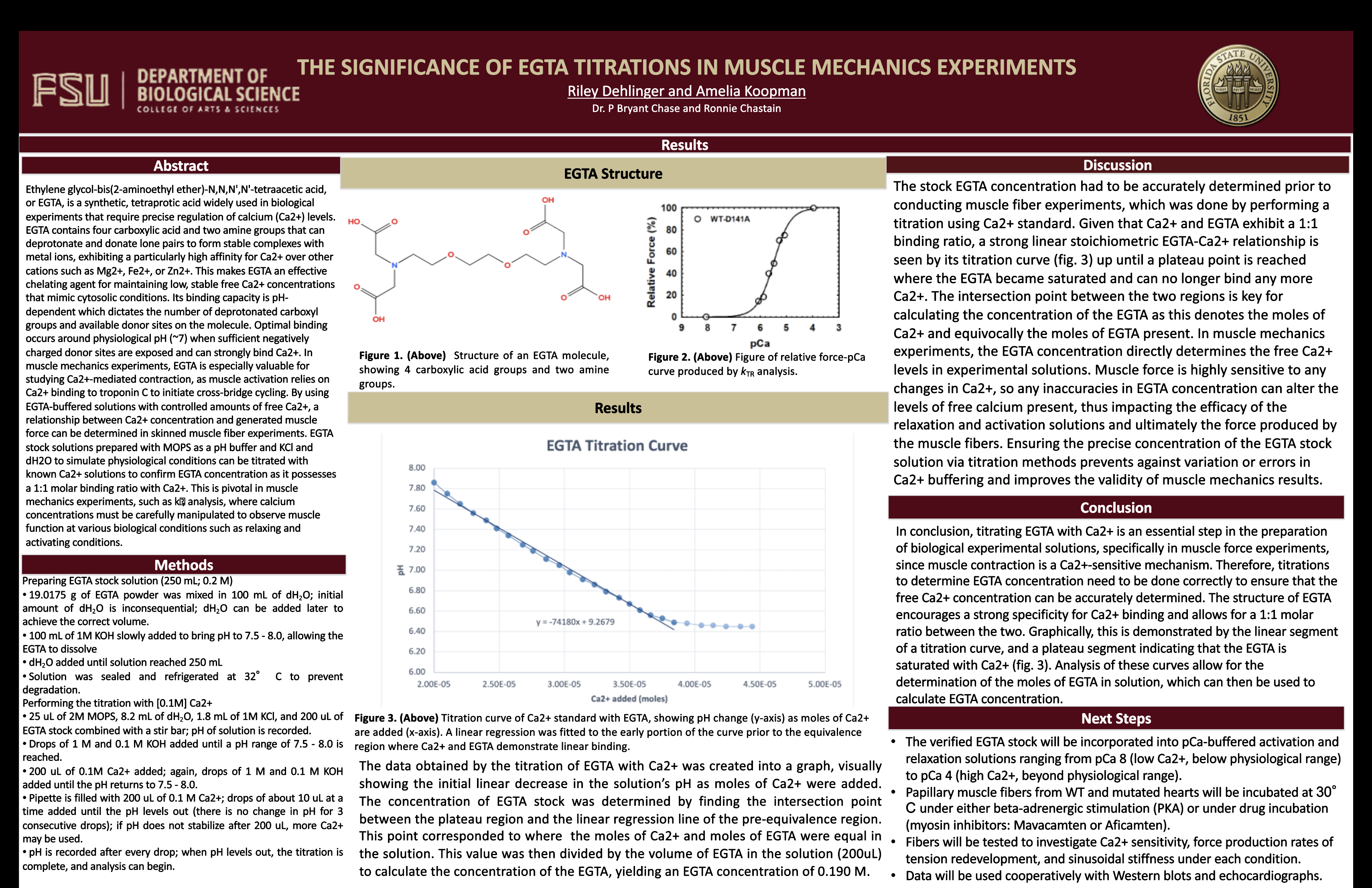
Ethylene glycol-bis(2-aminoethyl ether)-N,N,N',N'-tetraacetic acid, or EGTA, is a synthetic, tetraprotic acid widely used in biological experiments that require precise regulation of calcium (Ca2+) levels. EGTA contains four carboxylic acid and two amine groups that can deprotonate and donate lone pairs to form stable complexes with metal ions, exhibiting a particularly high affinity for Ca2+ over other cations such as Mg2+, Fe2+, or Zn2+. This makes EGTA an effective chelating agent for maintaining low, stable free Ca2+ concentrations that mimic cytosolic conditions. Its binding capacity is pH- dependent which dictates the number of deprotonated carboxyl groups and available donor sites on the molecule. Optimal binding occurs around physiological pH (~7) when sufficient negatively charged donor sites are exposed and can strongly bind Ca2+. In muscle mechanics experiments, EGTA is especially valuable for studying Ca2+-mediated contraction, as muscle activation relies on Ca2+ binding to troponin C to initiate cross-bridge cycling. By using EGTA-buffered solutions with controlled amounts of free Ca2+, a relationship between Ca2+ concentration and generated muscle force can be determined in skinned muscle fiber experiments. EGTA stock solutions prepared with MOPS as a pH buffer and KCl and dH2O to simulate physiological conditions can be titrated with known Ca2+ solutions to confirm EGTA concentration as it possesses a 1:1 molar binding ratio with Ca2+. This is pivotal in muscle mechanics experiments, such as kₜᵣ analysis, where calcium concentrations must be carefully manipulated to observe muscle function at various biological conditions such as relaxing and activating conditions.
Keywords: EGTA, Titration, Muscle Mechanics