
Research Symposium
26th annual Undergraduate Research Symposium, April 1, 2026
Manal Mohib Poster Session 2: 10:45 am - 11:45 am / Poster #34

BIO
Manal is a third year Economics major and Environmental Science and Policy minor student from Orlando, Florida. Her interests include public health, environmental studies, and working on projects pertaining to the betterment of people's lives. She is currently a public policy research intern at the DeVoe L. Moore Institute working under Dr. Crystal Taylor to study what relationship, if any, exists between asthma and housing factors.
Home Prices as an Indicator of Healthy Housing: An Examination of Home Prices and Sociodemographic Characteristics on Asthma Rates in Florida
Authors: Manal Mohib, Crystal TaylorStudent Major: Economics
Mentor: Crystal Taylor
Mentor's Department: Economics Mentor's College: College of Social Science and Public Policy Co-Presenters:
Abstract
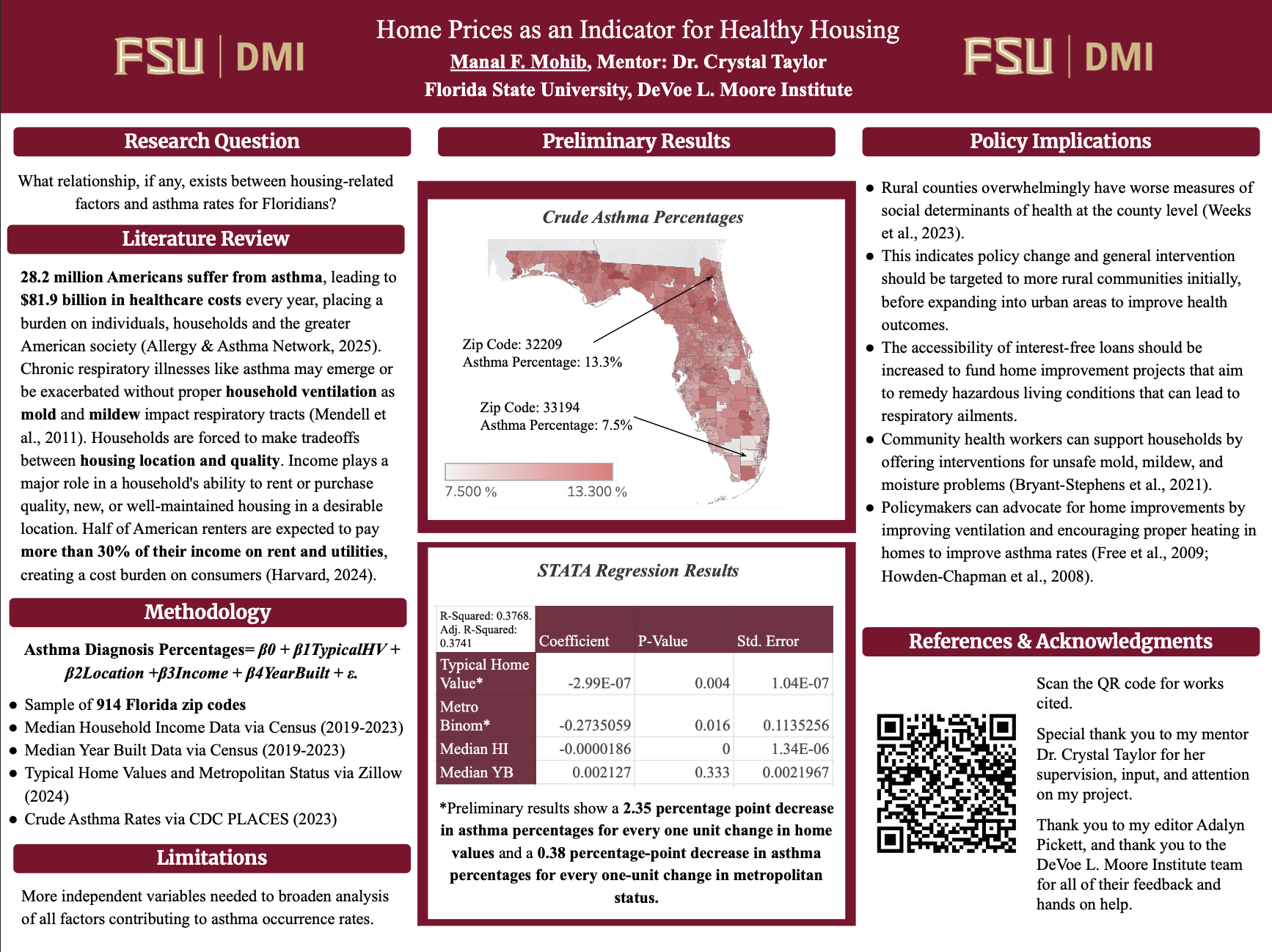
Almost 25 million people in the United States have asthma (CDC, 2021). Common household triggers for asthma include dust, pests, and mold (CDC, 2024). Income determines a household's ability to rent or purchase quality housing in a desirable environment. Expanding on literature (Bryant-Stephens et al., 2021; Free et al., 2009; Howden-Chapman, 2008; Künn et al., 2024), this research asks: What relationship, if any, exists between housing-related factors and asthma rates for Floridians?
Median household income data was obtained from the the Census (2019-2023), median year built of house from the Census (2019-2023), typical home value data and metropolitan status from the Zillow Home Value Index (2024), and asthma occurrence percentages from the Centers for Disease Control and Prevention’s Population Level Analysis and Community Estimates (2023). This research represents 914 zip codes in Florida. Using STATA, this study used regression analysis to test whether home price, location, and socioeconomic characteristics have an association with asthma occurrence rates.
For every one unit change in home values, asthma crude percentage decreases by 2.99. For every one unit change in metropolitan status, asthma crude percentage decreases by .27. However, to garner a comprehensive picture of what factors contribute to asthma rates, more independent variables should be added to future studies.
Community health workers can proactively support households by identifying and offering home interventions (Bryant-Stephens et al., 2021). Policymakers can advocate for home improvements by improving ventilation and encouraging proper heating in homes to improve asthma rates (Free et al., 2009; Howden-Chapman et al., 2008).
Keywords: health economics policy