
Research Symposium
26th annual Undergraduate Research Symposium, April 1, 2026
Alessandra Tiongson Poster Session 3: 1:45 pm - 2:45 pm / Poster #27

BIO
Alessandra Tiongson is a first year undergraduate student at Florida State University pursuing a Bachelor of Science in Cell and Molecular Neuroscience. She is involved in undergraduate research on mild cognitive impairment and spatial navigation under the mentorship of Dorota Kossowska-Kühn, PhD. Her interests include neuroscience, cognition, and clinical research. Alessandra is also active in service and leadership initiatives on campus such as the American Medical Women's Association, the Phi Delta Epsilon medical fraternity, and the Alpha Epsilon Delta national health pre-professional honor society. She plans to pursue medical school and a career that combines patient care with research.
Cognitive Skills Model for Predicting Alzheimer's Disease
Authors: Alessandra Tiongson, Dorota Kossowska-KühnStudent Major: Cell and Molecular Neuroscience
Mentor: Dorota Kossowska-Kühn
Mentor's Department: Psychology Mentor's College: Florida State University Co-Presenters: Graham Heisel, Breanna Francis, and Ambar Fernandez
Abstract
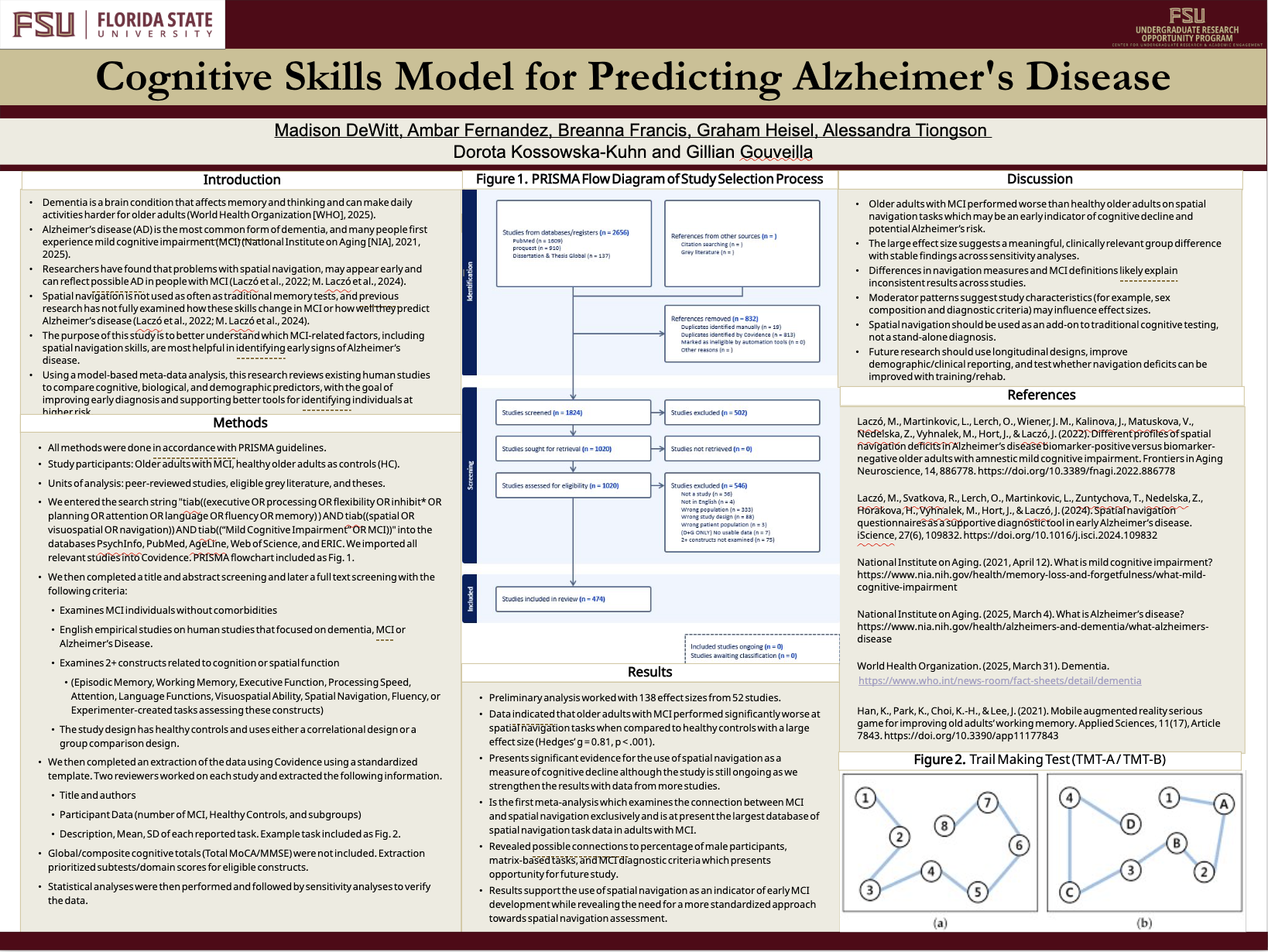
Mild Cognitive Impairment (MCI) is a condition in which individuals experience cognitive decline beyond what is expected with normal aging, while still being able to complete most daily activities independently. MCI is often viewed as an early stage that may precede Alzheimer’s disease (AD) and provides an important opportunity to identify early indicators of neurodegeneration, though not all individuals with MCI progress to AD. Because of this uncertainty, identifying reliable predictors of Alzheimer’s disease within MCI populations remains an ongoing challenge. The purpose of this study was to examine differences in domain-specific cognitive performance, including spatial navigation, between individuals with MCI and cognitively healthy older adults and to determine which cognitive areas show early decline. We started by importing 1,824 studies into the Covidence program, which were sorted through and screened for admission to the database. We then screened the articles based on title and abstract to roughly narrow the studies, and finally, we completed a full-text review to bring our final number of studies to 600 articles to be extracted. Results show that individuals with MCI perform worse than cognitively healthy older adults across several cognitive domains, including spatial navigation and memory. This shows the connection between spatial navigation tasks and older adults with MCI while highlighting the need for further measures of spatial navigation in screening. The connection proven by our study can be used to modify the current screening procedures in MCI and help better the methods for detecting cognitive decline during that critical early period.
Keywords: Alzheimer’s disease prediction, Mild cognitive impairment, Spatial navigation, Cognitive assessment, Early dementia detection