
Research Symposium
26th annual Undergraduate Research Symposium, April 1, 2026
Courtney Lesser Poster Session 1: 9:30 am - 10:30 am / Poster #271

BIO
Courtney Lesser is a Class of 2028 student at Florida State University pursuing a Bachelor of Science in Exercise Physiology. Striving for excellence, embracing challenges, and pursuing adventure in every aspect of life, she is motivated by a strong interest in the science of exercise, sports performance, and human health. Courtney has been named to the Dean’s List for three consecutive semesters, reflecting her commitment to academic distinction.
Originally from South Florida, Courtney brings a background of leadership and discipline developed through athletics. She is a two-time US Lacrosse Academic All-American, Jackie Pitts Award recipient, and former member of the FSU Women’s Club Lacrosse Team, experiences that strengthened her teamwork, resilience, and leadership both on and off the field.
Courtney is currently conducting undergraduate research through the Undergraduate Research Opportunity Program (UROP) at Florida State University under the mentorship of Hannah Eberhardt. Her work reflects her passion for applying scientific research to real-world performance and health outcomes.
Known for her attention to detail and drive for distinction, Courtney aims to merge her interests in research, athletics, and service in a future physician assistant career connecting human performance, medicine, and the military, where peak performance, resilience, and leadership are essential.
Energy Availability, Physical Fitness, and Macronutrient Intake in Air Force Reserve Officer Training Corps Cadets
Authors: Courtney Lesser, Hannah EberhardtStudent Major: Exercise Physiology
Mentor: Hannah Eberhardt
Mentor's Department: Institute of Sports Sciences and Medicine Mentor's College: Anne Spencer Daves College of Education, Health, and Human Sciences Co-Presenters:
Abstract
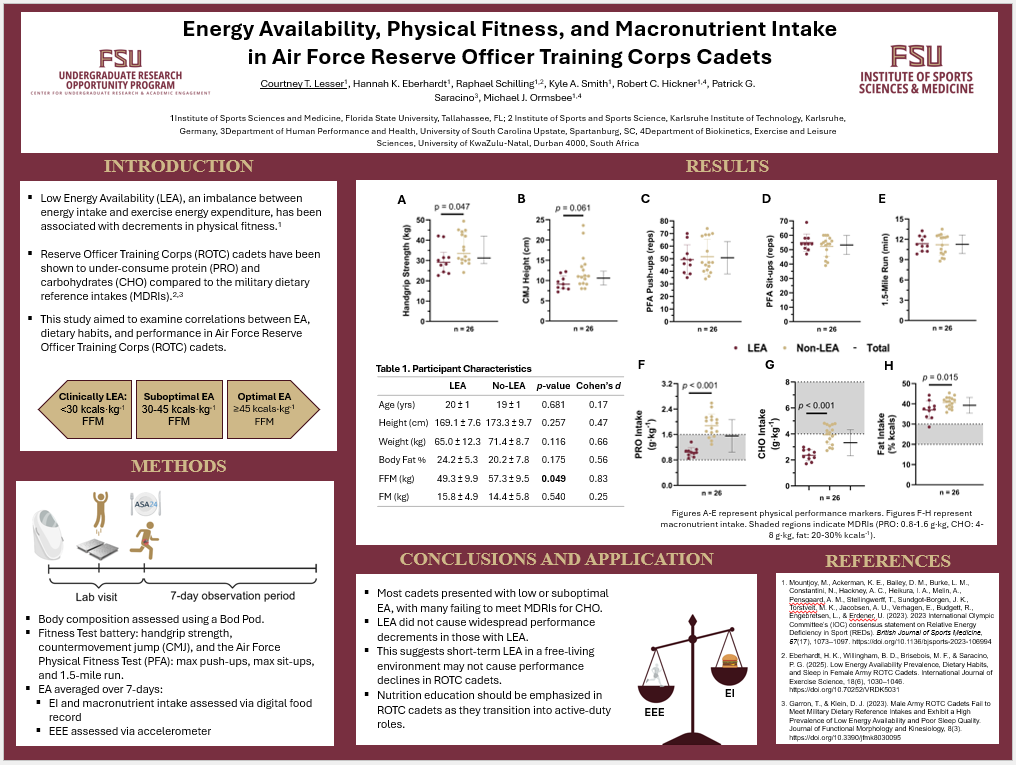
Introduction: No data exists examining associations between energy availability (EA) dietary habits, physical performance in Air Force Reserve Officer Training Corps (AFROTC) cadets. Therefore, this study aimed to examine correlations between EA, dietary habits, and performance in AFROTC cadets.
Methods: Twenty-six cadets (12 males, 14 females; 20 ± 1 yrs, ht: 171.6 ± 9.1 cm, wt: 69.2 ± 10.5 kg, mean body fat (BF%) 21.8 ± 7.1%, FFM 54.2 ± 10.3 kg) completed body composition testing and a battery of performance tests, including handgrip strength, countermovement jump (CMJ), isometric mid-thigh pull (IMTP), push-ups, and pull-ups. Physical Fitness Assessment (PFA) scores were collected from AF cadre. The Abridged Nutrition for Sports Knowledge Questionnaire (ANSQK) assessed nutrition knowledge. EA was estimated over 7-days using a digital food record to assess energy intake (EI) and accelerometry to measure exercise energy expenditure (EEE).
Results: Mean EA was 30.9 ± 12.5 kcals·kg-1 FFM, with 38.5% of cadets experiencing LEA and 46.2% in suboptimal EA. Mean EI was 2406 [1405] kcal·d⁻¹ and EEE was 580 ± 203 kcal·d⁻¹. Cadets consumed 3.3 ± 1.0 g·kg⁻¹ carbohydrate, 1.6 ± 0.5 g·kg⁻¹ protein, and 38% fat. Cadets with LEA consumed significantly less calories and macronutrients than those without (p < 0.05). Cadets with LEA exhibited lower handgrip strength (28.7 [5.3] vs. 42.1 [8.1] kg; p = 0.047). No other performance measures differed between LEA and non-LEA. Average nutrition knowledge scores were 63.6%.
Conclusions: These findings highlight nutrition education imperatives and targeted strategies to optimize performance in AFROTC cadets.
Keywords: Air Force, Energy Availability, Fitness