
Research Symposium
26th annual Undergraduate Research Symposium, April 1, 2026
Joseilys Quinones Poster Session 4: 3:00 pm - 4:00 pm / Poster #232

BIO
Joseilys is a freshmen Presidential Scholar at FSU from Kissimmee, Florida pursuing a Bachelor of Science in Meteorology and a Bachelor of Music in String Performance. Her research experience pertains to extreme weather research, with a specialized interest in hurricane and hurricane modeling. She has been awarded the Freshmen Undergraduate Scholarship by the American Meteorological Society and the Project Weather Scholarship by Spectrum News 13 for her achievements in STEM and her long-time interest in meteorology. She hopes to go to graduate school for meteorology, while keeping music performance in her life throughout her studies and career.
Evaluating Storm Energy Metrics as Indicators of Hurricane Structure and Duration
Authors: Joseilys Quinones, Dr. Jeremiah OteroStudent Major: Meteorology and Music Performance
Mentor: Dr. Jeremiah Otero
Mentor's Department: N/A Mentor's College: N/A Co-Presenters:
Abstract
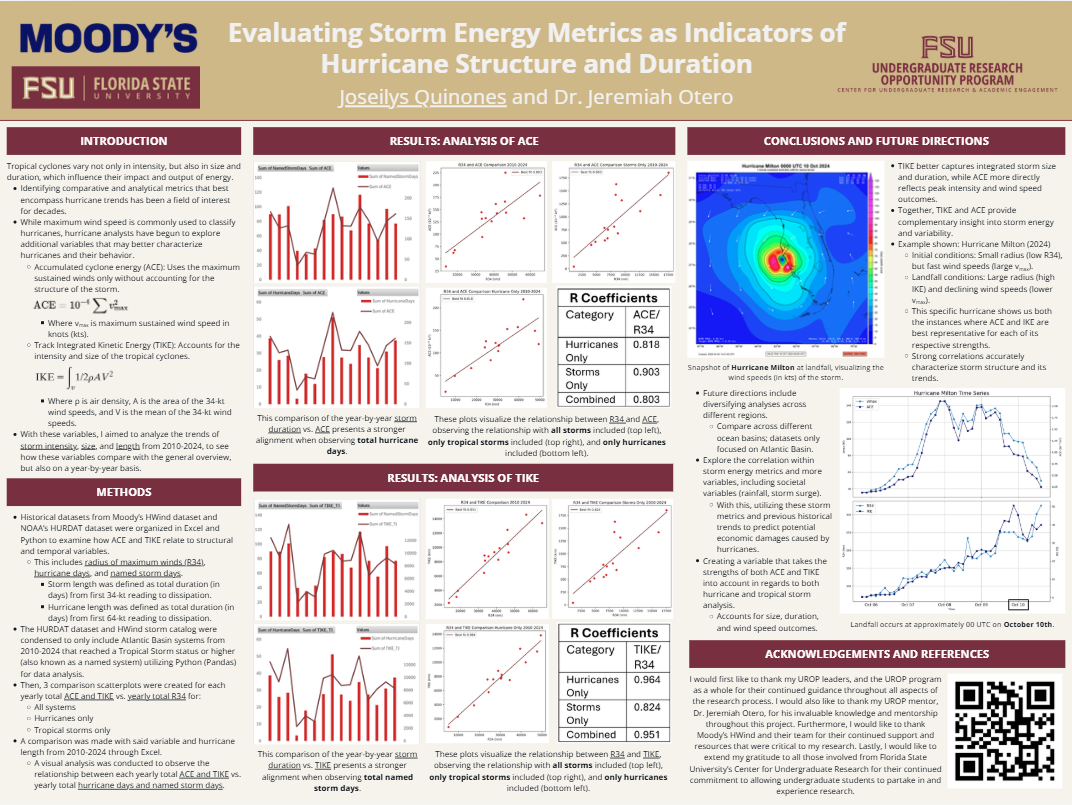
Tropical cyclones vary not only in intensity, but also in size and duration, which influence their impact and output of energy. Trying to find comparative and analytical values that best encompass hurricane trends has been a field of interest for decades. While maximum wind speed is commonly used to classify hurricanes, Accumulated cyclone energy (ACE) and Track Integrated Kinetic Energy (TIKE) provide a more comprehensive representation of storm strength over time and space. This project aims to analyze several analytical variables used to characterize hurricanes. Historical datasets from Moody’s HWind dataset and NOAA’s HURDAT dataset were organized in Excel and Python to examine how ACE and TIKE relate to structural and temporal variables, including radius of 34-kt winds (R34), hurricane days, and named storms days. Through correlation assessment and data visualization, this project determines whether trends in storm size, duration, and strength correspond with ACE and TIKE. Analysis showed opposite results from both ACE and TIKE when it came to storms vs. hurricanes. For hurricanes, TIKE is the better indicator of physical size, while ACE is better for measuring duration. These relationships reverse when analyzing broader named storm data. The strong link between storm length and ACE highlights the role of persistence in overall storm impact, while the relationship between R34 and TIKE suggests that storm size contributes substantially to total kinetic energy. Understanding these relationships improves insight into how hurricanes generate and distribute energy across regions.
Keywords: Meteorology, hurricanes, analysis