
Research Symposium
26th annual Undergraduate Research Symposium, April 1, 2026
Addison Delgado Poster Session 3: 1:45 pm - 2:45 pm / Poster #273

BIO
Addison is a second-year student from Williston, FL. At Florida State University, she is majoring in English (Literature, Media, and Culture) and Media/Communication. Her research during UROP with Dr. Neal from the Department of English explores visual representations of lesbian relationships on early twentieth-century postcards. Through this project, she has developed essential research, visual analysis, and archival skills. Outside of UROP, Addison is currently working on research for her Honors in the Major thesis, titled “Haunting (Post)-Slavery Stories: Ryan Coogler’s Sinners and Toni Morrison’s Beloved.” Additionally, she is actively involved in Her Campus FSU, Pride Student Union, and Southeast Review. Her involvements have allowed her to develop her editing, writing, and design skills, and she plans to attend graduate school after finishing her undergraduate studies.
Lesbian Relationships on Postcards
Authors: Addison Delgado, Michael NealStudent Major: English-Literature, Media, and Culture; Media/Communication
Mentor: Michael Neal
Mentor's Department: Department of English Mentor's College: College of Arts & Sciences Co-Presenters:
Abstract
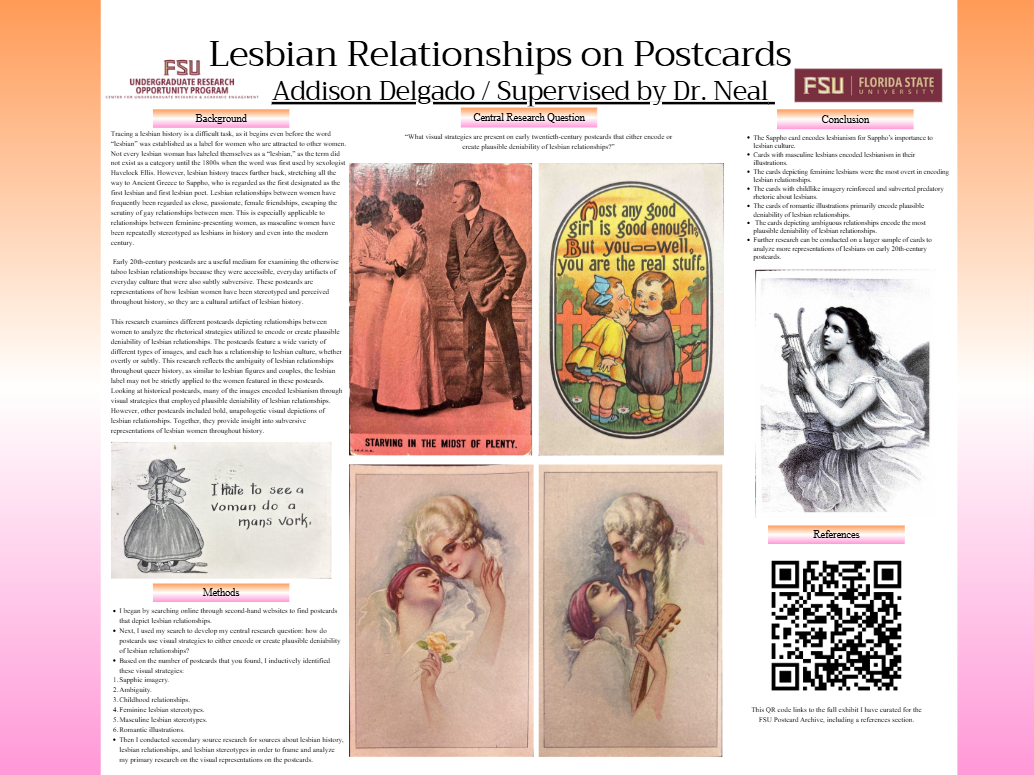
In my research, I investigated visual strategies that early twentieth-century postcards employed to subtly depict lesbian relationships. My work was guided by the central research question, “What visual strategies are present on early twentieth-century postcards that either encode or create plausible deniability of lesbian relationships?” After identifying postcards from the early 20th century that portrayed lesbian relationships, I conducted an inductive analysis that allowed me to identify the following visual strategies: Sappho, Lesbian Stereotypes, Childlike Imagery, Feminine Women/Lesbians, Romantic Illustrations, and Ambiguous Relationships. To further study my proposed subject, I conducted secondary scholarly sources through FSU databases on lesbians, lesbian history, and the stereotypical portrayals of lesbians in visual media. These frameworks helped me develop categories for the visual analysis of these cards, using a “lesbian perspective” to examine how each card encodes or creates plausible deniability of lesbian relationships. Each postcard was coded using one or more of the six main strategies, as several employed multiple simultaneously. Analyzing how these cards employ different visual strategies revealed further insights into how historical stereotypes of lesbian women shaped visual representations of lesbian relationships. Postcards are one of many visual media sources, but particularly interesting as cultural artifacts because they exist simultaneously in public and private spaces. Further research could look at a larger variety of cards, enhancing studies on how lesbian relationships are depicted in visual media by analyzing more representations of lesbian women.
Keywords: rhetoric, queer studies, lesbian, postcards, visual analysis