
UROP Project
Towards an AI-Driven Laboratory for Autonomous Assembly of van der Waals Quantum Materials
Quantum Materials, Artificial Intelligence, Nano technology
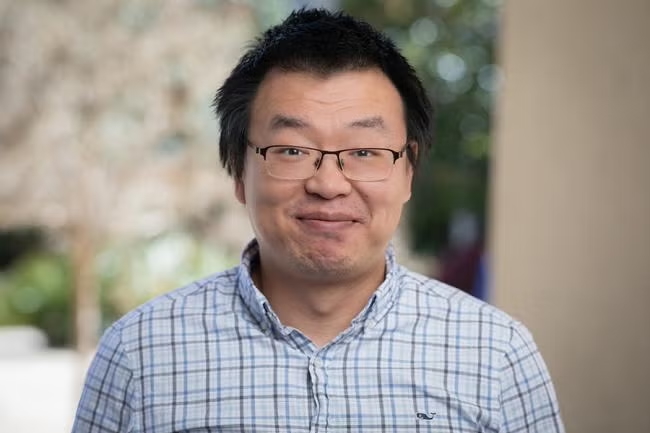
Research Mentor: zlu2@fsu.edu Zhengguang Lu, Dr.
Department, College, Affiliation: Department of Physics, Arts and Sciences
Contact Email: zlu2@fsu.edu
Research Assistant Supervisor (if different from mentor):
Research Assistant Supervisor Email:
Faculty Collaborators:
Faculty Collaborators Email:
Department, College, Affiliation: Department of Physics, Arts and Sciences
Contact Email: zlu2@fsu.edu
Research Assistant Supervisor (if different from mentor):
Research Assistant Supervisor Email:
Faculty Collaborators:
Faculty Collaborators Email:
Looking for Research Assistants: Yes
Number of Research Assistants: 2
Relevant Majors: Open to all majors
Project Location: On FSU Main Campus
Research Assistant Transportation Required: Remote or In-person: In-person
Approximate Weekly Hours: 8, Flexible schedule (Combination of business and outside of business. TBD between student and research mentor.)
Roundtable Times and Zoom Link:
Number of Research Assistants: 2
Relevant Majors: Open to all majors
Project Location: On FSU Main Campus
Research Assistant Transportation Required: Remote or In-person: In-person
Approximate Weekly Hours: 8, Flexible schedule (Combination of business and outside of business. TBD between student and research mentor.)
Roundtable Times and Zoom Link:
- Day: Monday, August 31
Start Time: 2:00
End Time: 4:00
Zoom Link: https://mit.zoom.us/j/6671590879 - Day: Tuesday, September 1
Start Time: 2:00
End Time: 5:30
Zoom Link: https://mit.zoom.us/j/6671590879 - Day: Wednesday, September 2
Start Time: 2:00
End Time: 5:30
Zoom Link: https://mit.zoom.us/j/6671590879 - Day: Thursday, September 3
Start Time: 5:00
End Time: 6:00
Zoom Link: https://mit.zoom.us/j/6671590879
Project Description
Atomically thin two-dimensional materials can be assembled layer by layer to create artificial materials with properties that do not exist naturally. These van der Waals (vdW) heterostructures provide an important platform for studying quantum phenomena including superconductivity, magnetism, topology, and strongly correlated electronic states. However, fabrication of these structures still relies heavily on researchers manually identifying microscopic flakes, aligning them under a microscope, controlling contact between layers, and adjusting many experimental parameters through trial and error. This limits both throughput and reproducibility.The goal of this project is to develop the foundation of an AI-driven vdW assembly laboratory in which computer vision, automated instrumentation, and AI agents work together with human researchers to fabricate two-dimensional heterostructures. The system will use optical images to identify and characterize suitable flakes, determine their position and orientation, assist with alignment and transfer, record experimental parameters and images throughout fabrication, and ultimately learn from previous assembly attempts.
A longer-term goal is to create a closed-loop experimental platform in which an AI system can not only execute predefined procedures but also recognize uncertainty or experimental failures, suggest corrective actions, and improve future fabrication strategies.
Undergraduate researchers will participate in developing and testing individual components of this system. Depending on their interests and background, students may focus on computer vision and machine learning, laboratory automation and robotics, 2D-material fabrication, or experimental-data analysis. The project therefore provides an opportunity to work at the intersection of artificial intelligence, experimental physics, robotics, and quantum materials while contributing to the development of a new approach to scientific experimentation.
Research Tasks: Research assistants will contribute to one or more of the following components:
1. Literature review and AI-driven system design
Study recent developments in AI-driven scientific laboratories, autonomous experimentation, computer vision, and automated fabrication of 2D materials. Identify experimental steps in vdW fabrication that can be automated or assisted by AI.
2. Computer vision for 2D materials
Collect and organize optical microscope images of graphene, hBN, and other two-dimensional materials. Annotate images to create training and validation datasets.Develop or evaluate algorithms for detecting flakes and determining their size, shape, thickness contrast, orientation, and location. Quantitatively evaluate detection accuracy and reliability.
3. Automated microscope and assembly control
Develop Python-based interfaces for cameras, motorized stages, microscope focus, and other components of a vdW transfer system. Implement automated positioning, focusing, image acquisition, alignment, and tracking procedures. Establish deterministic safety limits so that automated or AI-generated commands cannot damage samples or equipment.
4. Closed-loop AI-assisted assembly
Record images, stage coordinates, temperatures, alignment parameters, and experimental outcomes during assembly. Develop methods for detecting unsuccessful alignment, loss of focus, contamination, or uncertain flake identification.Explore AI-agent workflows that analyze the current experimental state and recommend the next appropriate action while leaving hardware execution to validated control software.
5. Hands-on Nano fabrication of real quantum chip
6. Testing and benchmarking
Perform controlled tests using graphene, hBN, and related 2D materials. Compare AI-assisted and conventional manual procedures in terms of accuracy, reproducibility, time, and success rate. Document results and contribute to the development of the final UROP research poster.
The exact tasks will be matched to the student's interests and experience. A student is not expected to complete the entire autonomous laboratory during one UROP project; instead, each student will take ownership of a well-defined component that contributes to the larger platform.
Skills that research assistant(s) may need: Required:
Curiosity and strong interest in experimental science, artificial intelligence, robotics, or quantum materials. Willingness to learn new laboratory and computational techniques. Careful attention to detail and ability to document work systematically. Ability to work both independently and collaboratively.
Recommended, but not required:
Basic Python programming. Experience or coursework in physics, computer science, engineering, mathematics, or a related area. Familiarity with image processing, computer vision, machine learning, or neural networks. Experience with microscopes, electronics, robotics, motorized stages, or instrumentation. Interest in hands-on experimental work.
Students with a primarily computational background and students with a primarily experimental background are both encouraged to apply.