
Research Symposium
26th annual Undergraduate Research Symposium, April 1, 2026
Nghi (Minci) Tran Poster Session 4: 3:00 pm - 4:00 pm / Poster #76

BIO
Nghi (Minci) Van Tran is a second-year student from Vietnam pursuing a Bachelor of Science degree in Chemistry. She is an research assistant in Dr. Jack Saltiel's group, and currently she is researching the photochemistry of a molecule called 1,4-diphenyl-1,3-butadiene -- specifically how it isomerizes when react to light. Besides chemistry, Nghi is pursuing an FSU-Teach Certificate and a minor in English. Nghi is also a Service Scholar and an executive board member of the Pride Student Union and Generation Action at FSU.
Photoisomerization of cis,trans-1,4-diphenyl-1,3-butadiene
Authors: Nghi (Minci) Tran, Jack SaltielStudent Major: Biochemistry
Mentor: Jack Saltiel
Mentor's Department: Department of Chemistry and Biochemistry Mentor's College: College of Arts and Sciences Co-Presenters: none
Abstract
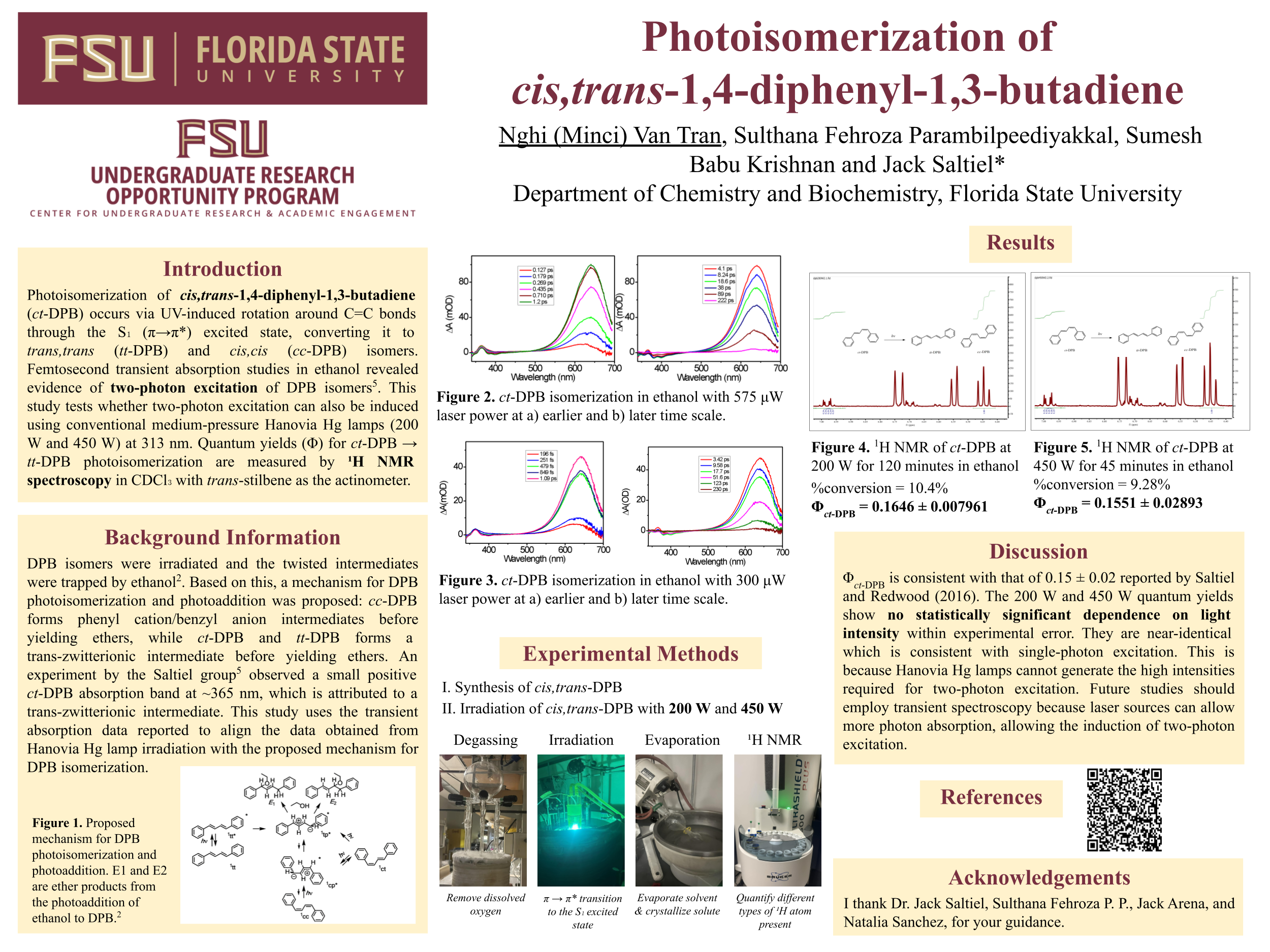
Photoisomerization of cis,trans-1,4-diphenyl-1,3-butadiene (ct-DPB) occurs via UV-induced rotation around C=C bonds through the S₁ (π→π*) excited state, converting it to trans,trans (tt-DPB) and cis,cis (cc-DPB) isomers. A previous femtosecond transient absorption study in ethanol revealed evidence of two-photon excitation of DPB isomers. This study tests whether two-photon excitation can also be induced using conventional medium-pressure Hanovia Hg lamps (200 W and 450 W) at 313 nm. Quantum yields for ct-DPB → tt-DPB photoisomerization are measured by ¹H NMR spectroscopy in CDCl₃ with trans-stilbene as the actinometer. The measured quantum yields of ct-DPB is 0.1646 ± 0.007961 at 200 W and 0.1551 ± 0.02893 at 450 W, consistent with that of 0.15 ± 0.02 reported by the literature. The 200 W and 450 W quantum yields show no statistically significant dependence on light intensity within experimental error. They are near-identical which is consistent with single-photon excitation. This is because Hanovia Hg lamps cannot generate the high intensities required for two-photon excitation. Future studies should employ transient spectroscopy because laser sources can allow more photon absorption, allowing the induction of two-photon excitation.
Keywords: nghi tran minci photochemistry cis,trans-1,4-diphenyl-1,3-butadiene