
Research Symposium
26th annual Undergraduate Research Symposium, April 1, 2026
Vivian Liu Poster Session 4: 3:00 pm - 4:00 pm / Poster #190

BIO
Vivian Liu is a sophomore double-majoring in Statistics and Psychology with a minor in Mathematics. Originally from New York, she moved to Fort Myers, Florida, in high school. After being guided by her amazing research mentor, Dr. Lauren Rice, in the Undergraduate Research Opportunity Program here at FSU, she has taken an interest in working in environmental science labs and would love to continue down this path. Vivian hopes to explore research that intersects the fields of Statistics, Psychology, and Environmental Science.
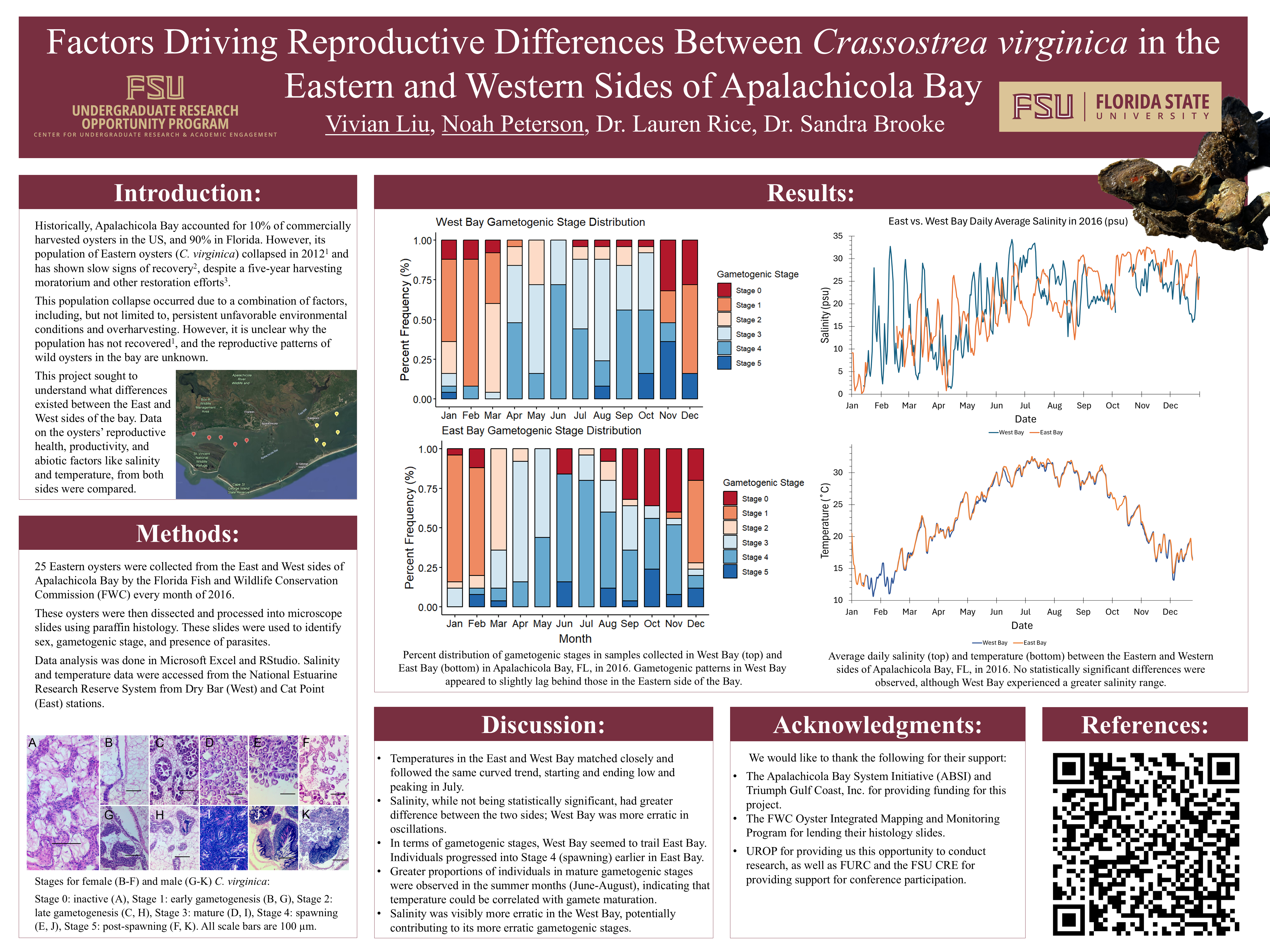
Factors Driving Reproductive Differences Between Crassostrea virginica in the Eastern and Western Sides of Apalachicola Bay
Authors: Vivian Liu, Dr. Lauren RiceStudent Major: Statistics & Psychology
Mentor: Dr. Lauren Rice
Mentor's Department: Department of Earth, Ocean, and Atmospheric Science Mentor's College: College of Arts and Sciences Co-Presenters: Noah Peterson
Abstract
Apalachicola Bay in Florida supports wild populations of the Eastern oyster (Crassostrea virginica), whose historical prevalence supplied 90% of all oysters sold in Florida. After their collapse in 2012, the oyster population has shown slow signs of recovery despite various restoration efforts, including a 2020 harvest moratorium. As part of the Apalachicola Bay System Initiative project at the Florida State University Coastal and Marine Lab, our study seeks to determine the environmental factors that are driving oyster reproductive patterns on the eastern and western regions of Apalachicola Bay. To do this, 25 oysters were collected each month in 2016 from both sides of Apalachicola Bay and then processed by the Florida Fish and Wildlife Conservation Commission using paraffin histology. Slides of each individual were viewed using light microscopy and categorized as either: inactive, early gametogenesis, late gametogenesis, mature, spawning, or post-spawning, and parasite presence and instances of hermaphroditism were recorded. Then, 100 randomly selected oocytes were measured from each female, when possible. Water quality and nutrient data collected in 2016 were accessed from the National Estuarine Research Reserve System to examine potential environmental differences across the bay. These data will be used to identify possible correlations between oyster reproduction and environmental conditions, and can be used to make inferences about oyster population reproductive potential across Apalachicola Bay. In doing so, our project will contribute towards larger initiatives to identify long-term trends of oyster reproductive health, environmental drivers, and help contribute towards data-informed management strategies.
Keywords: Apalachicola Bay, Oysters, Salinity, Temperature